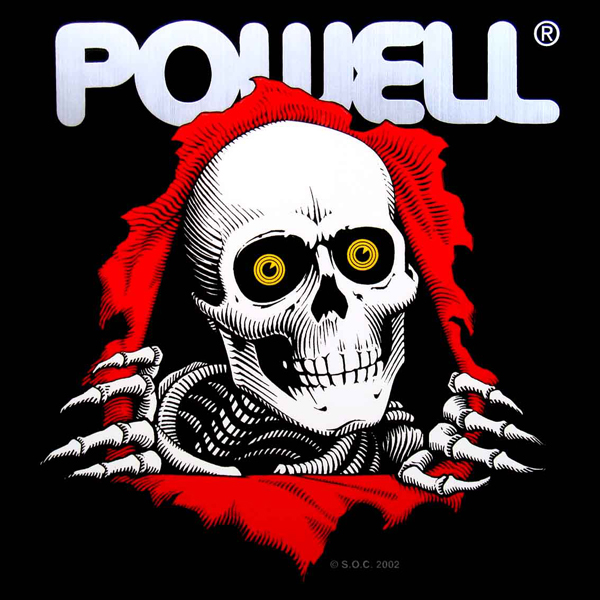
On January 23rd, 2009, Powell-Peralta hosted the Rip the Ripper Art Show. Fifty eight artists had pieces on display. The reason for the show was to celebrate The Ripper graphic. So many skaters and artists have been influenced by VCJ’s image over the years, we wanted to do something that would pay respect to VCJ and get skaters stoked. We invited a group of artists and asked them to interpret The Ripper in their own style. Curator: Désirée Astorga
Introduction to The Ripper
The Ripper was created by Vernon Courtlandt Johnson(VCJ) in 1978. It was developed over a period of about six months, during which the basic concept of a skull breaking through a barrier evolved through a number of evolutions, each of which simplified and strengthened the basic image. It was purposely undertaken as a follow up to the tremendous success of Court’s first graphic, the Skull and Sword, which had been drawn for our first pro skater, Ray Rodriguez, the year before.
When Court undertook the development of the Skull and Sword, he started with only a scribble on the back of a matchbook we received from Ray. It didn’t really look like a skull and sword, but that’s what Ray said it was, so we believed him, and Court set out to make it look a little more like one.
Skull and Sword was to be Court’s first graphic and would require a conscious departure from his original fine line “0000 Rapidigraph crosshatch” style so we could silkscreen it. Since he was learning to use MC Escher’s unique shading style and had to apply it to a skull, he asked if we could buy a skeleton to draw from, and so we did. Rosie, our medical supply skeleton, still resides in the Skate One Art Department thirty years later, but she is a little ‘worn’…
In the case of the Skull and Sword, Court was just trying to create a strong graphic that would please both Ray and the skaters of the 1970s. When he succeeded beyond all our expectations on his first try, we asked ourselves what it was that made the Skull and Sword so popular? I hit on the idea that Court had unwittingly created or tied into a Jungian archetype, and it struck people on a subconscious level, meaning many things to many people; things like overcoming fear of death, the power of the warrior, eternal life, conflict, or death. It never occurred to us that many of the conservative Christian movement would find it satanic and attempt to boycott our products because of it.
So with this initial success and my half-baked analysis in mind, Court set out to find another iteration of the human skull that would find similar pathways into the spirit of our times and endear itself to skaters. I believe it was Court who first suggested a skull popping through a wall during our brainstorming sessions, and it sounded great to me so I encouraged him to develop it.
Looking back thirty years to the days Court was creating The Ripper, I remember two issues that took a lot of iterations to perfect. One was the actual ripped background, which evolved from a broken wall to fabric folded back in shreds, to one stretched tight between the hands and skull to create both the tension between the background and the skeleton and the frozen moment in time created by this static position. The second was the eyes. Court went through a dozen different sets of eyes searching for one that was not too dark or too whimsical, but just light enough to put a smile on your face instead of horror.
The Ripper was initially used for a Bones T-shirt design, but it became so popular that it was eventually used on a number of decks, T-shirts, catalogs, stickers, Bones Brigade Video introductions, Powell-Peralta shipping boxes, and even Powell-Peralta pant labels.
Over the first 8-10 years, The Ripper became so synonymous with Bones, The Bones Brigade, and Powell-Peralta, that it was eventually used to parody Powell-Peralta by Blind and Shorty’s, during the marketing wars of the late 1980s. Since then, many artists have also found The Ripper’s basic gestalt of use in promoting many other brands and cultural icons. It is one of the most ripped-off graphics in our industry, and has even made its way out of the skateboard industry into our society at large and sometimes used as a symbol of the skate industry or youth culture.
Given the fact that The Ripper is still in use today going strong, it is certainly the most popular and long lasting graphic design to come out of the skateboard industry, having endured 25 years of changing markets and styles. It is quite an achievement for any piece of commercial art, especially in today’s disposable art culture.
I have always felt this was Court’s most successful graphic and the one that best reflects his wonderful, quirky and whimsical sense of humor. Thus, it seems fitting to see the finest artists of today’s skate culture celebrate The Ripper in such whimsical, humorous, amazing ways.
I offer my heartfelt thanks to all the artists that have chosen to honor Court and his Ripper in this show, and finally I offer my biggest thanks of all to Vernon Courtlandt Johnson, who has inspired many of today’s artists, and continues to offer inspiration to this very day.
— George A. Powell
All content on this page courtesy Powell Peralta Skateboards